Seed vs Series A: What Startup Funding Stage Are You?
Not sure if you're seed or Series A ready? Break down each startup funding stage, what investors expect, and how to know where you stand.
By Alex Mercer · 6 min read ·

Introduction#
Raising startup funding is not a linear process, and the labels attached to each round carry specific expectations that many founders misread. The gap between a seed round and a Series A is not just about check size; it reflects a fundamental shift in what investors expect to see in your product, revenue, and team. In the United States, where the venture ecosystem has grown increasingly stage-selective, pitching the wrong tier of investor wastes months of runway you cannot afford to lose. Knowing exactly where you sit on the funding continuum, and what signals move you to the next level, is the difference between a closed round and a dead conversation.
Mapping the Early Funding Stages#
Before comparing seed and Series A directly, it helps to establish the full spectrum of early-stage startup capital. Each phase exists to solve a specific problem: validating an idea, building a product, or proving a business model can scale. Conflating these stages leads founders to approach investors with the wrong narrative, the wrong ask, and the wrong metrics.
Pre-Seed and Bootstrapping: The Starting Line#
Pre-seed funding covers the earliest financial support a company receives, typically before a product exists in any meaningful form. At this stage, the goal is simple: get enough capital to build a prototype and test whether anyone cares. Here is how the landscape breaks down at this level:
Check sizes: Pre-seed rounds in the US generally range from $50K to $500K, though outliers exist in competitive markets like AI and biotech.
Investor profile: Angel investors for startups dominate this tier, alongside friends-and-family rounds and micro-VCs with dedicated pre-seed mandates.
Traction expectations: Investors are betting on the team and the problem, not on revenue, so a compelling founder-market fit and a clear hypothesis matter most.
Bootstrapping alternative: Many founders skip pre-seed entirely by bootstrapping a startup with personal savings or early customer revenue, retaining full equity but moving slower.
Accelerator programs: Programs like Y Combinator and Techstars function as structured pre-seed vehicles, offering small checks ($125K to $500K) plus mentorship in exchange for equity typically between 5% and 10%.
Seed Funding: Proving the Concept#
Seed funding for startups is where a company transitions from idea to early product. The round is designed to fund a team through 12 to 18 months of building, testing, and iterating until there is enough evidence to justify a larger raise. In 2025 and into 2026, median seed rounds in the US have settled around $2.5M to $4M, though this varies sharply by sector. A SaaS company might close seed at $3M on a $12M post-money valuation, while a deep-tech company with longer timelines might raise $5M at a higher cap.
The defining signal at seed is product-market fit exploration, not proof. Investors at this stage, typically seed-focused VCs and institutional funds with early-stage mandates, want to see that you have launched something, attracted early users or customers, and are generating enough signal to form hypotheses about growth. They are not expecting $1M in ARR. They are expecting clear evidence that the problem is real and that your approach to solving it has traction potential.
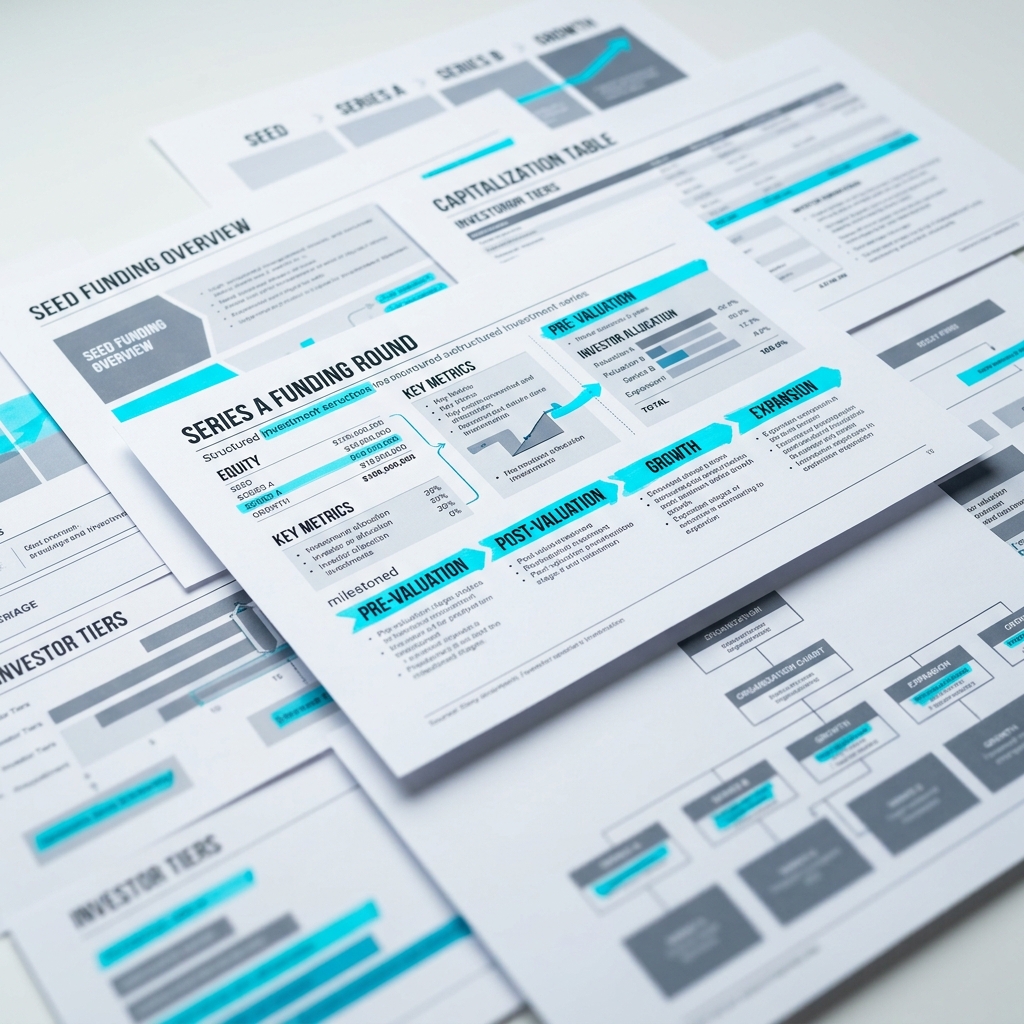
Series A and Beyond: Scaling With Proof#
The jump from seed to Series A is the steepest cliff in venture capital for startups. It is not a continuation of the same conversation. Series A investors operate on an entirely different rubric, one built around quantifiable business performance rather than narrative potential. Understanding what sits on the other side of that cliff, and how to reach it, determines whether a company survives the transition or stalls in the often-unforgiving gap between stages.
Series A Benchmarks: What Investors Actually Expect#
Series A funding in the US now typically ranges from $8M to $20M, with median rounds hovering around $12M as of early 2026. Valuations at this stage generally fall between $40M and $80M post-money, though AI-native companies have pushed well above that ceiling. The investors writing these checks are institutional VCs managing funds of $200M or more, firms like Andreessen Horowitz, Sequoia, or Bessemer that deploy startup capital with the expectation of a 10x return on each deal.
What do they require? The answer is specific. For SaaS businesses, the benchmark is roughly $1M to $2M in ARR with strong month-over-month growth (10% to 15%). For consumer products, it might be hundreds of thousands of active users with clear retention curves. For marketplace models, gross merchandise value and take rates matter more than raw revenue. The common thread across all categories is repeatable, measurable traction that suggests a scalable business model. Investors at this level are no longer funding a hypothesis; they are funding execution on a validated plan.
The Gap Between Seed and Series A#
This transition is where most startups fail. According to industry data, roughly 60% to 70% of seed-funded companies never raise a Series A. The reasons vary, but they tend to cluster around a few common failures: the product achieved modest traction but could not demonstrate a growth trajectory, the unit economics did not hold up under scrutiny, or the founding team could not articulate a credible path to a large market.
The gap is also structural. Seed investors expect you to use their capital to find product-market fit. Series A investors expect you to have already found it. That leaves founders in a paradox: they need to prove scale potential without the resources to actually scale. The best startup funding sources at this intermediate point include bridge rounds, revenue-based financing, and strategic angels who can provide both capital and operational support while a company builds toward the metrics that institutional VCs demand. Recent examples, like lean teams raising significant rounds on the strength of focused execution, illustrate what targeted traction can accomplish.
Federal startup grants and non-dilutive funding can also play a role here. Programs like the NSF SBIR/STTR grants offer up to $2M in non-dilutive capital for tech startup funding in the USA, particularly in deep-tech verticals like biotech, clean energy, and advanced manufacturing. These grants do not solve the Series A problem on their own, but they extend runway and reduce dilution during a critical growth phase.

Conclusion#
The distinction between seed and Series A is not about labels or round sizes. It is about what a company has proven. Seed is the stage where founders validate the problem and the early product; Series A is where they demonstrate that the business can grow predictably and at scale. Founders who understand this distinction, and who build their milestones around the specific metrics each stage requires, will approach investors with sharper narratives and close rounds faster. TechBriefed covers these funding developments daily, helping founders and VCs track the signals that define each stage of the venture lifecycle.
Stay ahead of startup funding trends by subscribing to the TechBriefed daily briefing.
Frequently Asked Questions (FAQs)#
What is seed funding?#
Seed funding is the first significant round of institutional or angel capital a startup raises, typically between $2M and $4M, used to build a product, hire an early team, and validate initial market demand.
What is pre-seed funding?#
Pre-seed funding is the earliest stage of external capital, usually ranging from $50K to $500K, raised from angel investors, accelerator programs, or friends and family to build a prototype and test a core hypothesis.
What do venture capitalists look for?#
Venture capitalists evaluate a combination of market size, founding team strength, product traction, unit economics, and a credible path to a large exit, with the specific weight of each factor shifting depending on the funding stage.
How do angel investors work?#
Angel investors are high-net-worth individuals who invest personal capital into early-stage startups, typically through convertible notes or SAFE agreements, in exchange for equity and often provide mentorship alongside their checks.
What is Series A funding?#
Series A funding is a startup's first major institutional round, typically ranging from $8M to $20M in the US, raised from venture capital firms after the company has demonstrated strong product-market fit and repeatable growth metrics.
About the author