Best Open Source AI Tools Builders Are Using in 2026
Discover the best open source AI tools builders are actually using in 2026. A curated, no-hype breakdown of frameworks, LLMs, and dev tooling worth your time.
By Alex Mercer · 6 min read ·

Introduction#
The economics of proprietary AI have shifted enough that open source AI is no longer the scrappy alternative. It is the default starting point for a growing number of engineering teams evaluating cost, control, and long-term architectural flexibility. In 2026, the open source ecosystem across the United States and globally has crossed a maturity threshold where production-grade deployments are routine, not experimental. Vendor lock-in now carries real balance-sheet consequences, and the tooling available to avoid it has never been stronger. The gap between the best open source AI tools and their closed counterparts is narrower than most vendor pitch decks would have you believe.
The Open Source AI Stack Worth Knowing#
Picking the right tools requires understanding where each one sits in the modern AI stack. The landscape spans foundation models, inference engines, orchestration frameworks, vector databases, and fine-tuning pipelines. Rather than cataloguing every project with a GitHub star count, the focus here is on the tools that have earned adoption through real production use and active community investment.
Foundation Models That Actually Ship#
The open source LLM space has consolidated around a handful of model families that teams trust for commercial workloads. Each one trades off differently on size, licensing, and task specialization, and picking the right one depends entirely on what you are building.
Meta Llama 4: The current default for teams wanting a general-purpose model with permissive licensing, strong multilingual support, and a deep ecosystem of fine-tuning guides and quantized variants.
Mistral Large 2: A top choice for European and multilingual deployments, with competitive reasoning benchmarks and a licensing model that works for most commercial scenarios.
DeepSeek-V3: Particularly strong for code generation and technical reasoning tasks, this model has gained traction among developer-tool startups in the US and Asia.
Qwen 2.5: Alibaba's contribution to the open source AI models pool has proven surprisingly capable at long-context tasks and structured output generation.
Phi-4 Mini: Microsoft's compact model punches well above its parameter count, making it the go-to for cost-sensitive inference on edge devices and constrained infrastructure.
Inference and Serving Infrastructure#
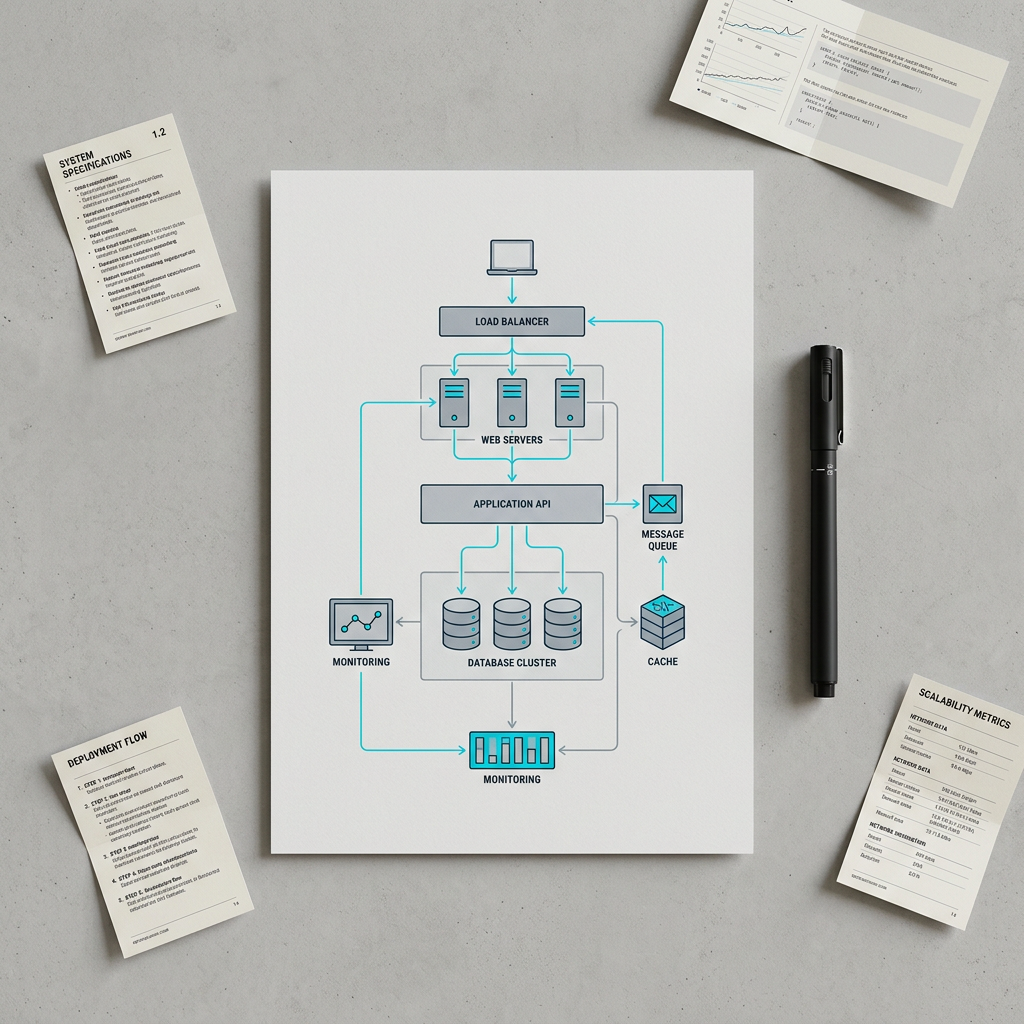
A great model is useless without a fast, reliable way to serve it. This is where the open source ecosystem has made its most dramatic gains over the past year. vLLM remains the standard for high-throughput serving of large language models, with its PagedAttention mechanism cutting memory waste and enabling significantly higher concurrency on the same GPU hardware. For teams that need a more opinionated deployment framework, BentoML provides a full packaging and serving pipeline that simplifies moving from notebook to production endpoint. Ollama has carved out a role as the fastest path to running models locally for development and prototyping, though scaling it beyond a single node still requires pairing it with orchestration tools like Ray Serve.
Frameworks, Databases, and the Connective Tissue#
Models and inference engines get the headlines, but the frameworks and data layers that connect them to real applications are where engineering teams spend most of their integration time. The right open source AI framework choice here can save months of custom plumbing.
Orchestration and RAG Tooling#
Retrieval-augmented generation has become the dominant pattern for building AI applications that need access to private or frequently updated data. LangChain and LlamaIndex are the two most adopted orchestration frameworks, and by 2026, both have matured past their early "demo-ware" reputations. LangChain's modular chain architecture now supports complex multi-step agents with better observability hooks. LlamaIndex, meanwhile, has leaned into structured data retrieval and is often the better pick when your RAG pipeline needs to pull from databases, APIs, and documents simultaneously.
On the vector database side, the choices have real architectural implications. Qdrant has emerged as a top-rated platform for teams that want a purpose-built, Rust-based vector store with strong filtering and hybrid search capabilities. For teams already running PostgreSQL, pgvector offers a lower-friction path by embedding vector search directly into an existing database, avoiding the operational overhead of a separate system. Weaviate and Chroma round out the field, with Weaviate favored for multi-modal use cases and Chroma popular for rapid prototyping. The decision often comes down to whether you want a dedicated vector engine or prefer to keep your infrastructure footprint small.
Fine-Tuning and Training Pipelines#
Off-the-shelf models rarely fit a specific product need without adaptation. The open source machine learning ecosystem now offers several credible paths for fine-tuning without requiring a dedicated ML platform team. Hugging Face's Transformers library, paired with PEFT (Parameter-Efficient Fine-Tuning) remains the most well-documented and broadly supported approach. Axolotl has gained popularity as a configuration-driven wrapper that simplifies multi-GPU fine-tuning workflows. For teams fine-tuning Llama models specifically, the combination of Unsloth for memory optimization and Weights & Biases for experiment tracking has become a nearly standard stack.
The critical consideration for open source AI development is evaluation. Model benchmarks published by the community are a useful starting point, but they rarely reflect how a model will perform on your specific task distribution. Teams that invest early in domain-specific evaluation datasets, even small ones of 200 to 500 examples, consistently make better fine-tuning decisions than those relying solely on public leaderboards. As one recent research survey noted, the disconnect between benchmark performance and real-world utility remains one of the most persistent challenges in open source AI ecosystems.

Conclusion#
The open source AI tools landscape in 2026 is deep enough that building a competitive, production-grade AI product without touching a proprietary API is genuinely feasible. The tradeoff is operational responsibility: you own the serving, the fine-tuning, the evaluation, and the upgrades. For teams with the engineering capacity to absorb that, the payoff is full control over cost, data, and architecture. TechBriefed covers these shifts daily because the decisions made at this layer of the stack have outsized impact on what ships six months from now. Start with the model and serving layer that fits your latency and budget constraints, build your evaluation pipeline before you build your product, and treat every tool recommendation (including this one) as a starting point for your own testing.
Stay ahead of the tools shaping the AI stack. Get the daily briefing at TechBriefed.
Frequently Asked Questions (FAQs)#
What is open source AI?#
Open source AI refers to artificial intelligence software, models, and frameworks whose source code and (in most cases) model weights are publicly available for inspection, modification, and redistribution under an approved license.
Can I use open source AI commercially?#
Most major open source AI models like Llama 4 and Mistral carry permissive or semi-permissive licenses that allow commercial use, though each license has specific terms around attribution and usage thresholds that should be reviewed by legal counsel before deployment.
How do open source AI models compare to proprietary ones?#
Top-tier open source models now match or closely approach proprietary alternatives on most standard benchmarks, with the primary remaining gaps found in specialized multimodal reasoning and long-horizon agentic tasks where frontier labs invest heavily in proprietary post-training techniques.
Is open source AI production-ready?#
Yes, open source AI is production-ready for a wide range of use cases, provided teams invest in proper serving infrastructure, monitoring, and evaluation pipelines rather than treating deployment as an afterthought.
Which open source AI framework should I use?#
The best framework depends on your use case: LangChain suits complex agent workflows, LlamaIndex excels at structured data retrieval, and Hugging Face Transformers remains the most versatile choice for model loading, fine-tuning, and experimentation across different architectures.
About the author