Humanoid Robots vs Industrial Robots: Which Wins in 2026?
A 2026 breakdown of how humanoid robots compare to traditional industrial robotic arms across cost, flexibility, and real-world manufacturing adoption.
By Alex Mercer · 9 min read ·

Quick Answer
Industrial robotic arms win most factory deployments in 2026 because they are proven, purpose-built systems for repeatable work. Humanoid robots are more adaptable where facilities were designed for people, but their commercial value still depends on reliable locomotion, manipulation, safety validation, and integration costs that vary by site.
Introduction
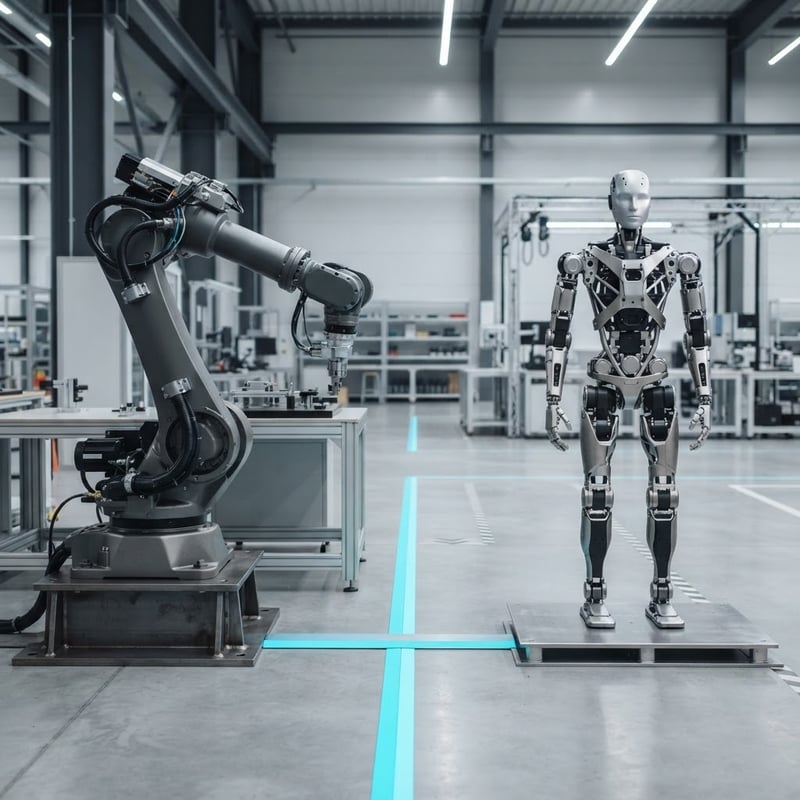
The practical answer in the humanoid robot vs industrial robotic arm debate is not that one form factor replaces the other. Fixed industrial arms remain the operational default for tightly defined tasks, while humanoids address environments where redesigning workstations, tooling, and pathways would be expensive or disruptive. According to the history of robots, the first uses of modern robots were in factories as fixed industrial machines, decades before general-purpose mobile systems became commercially viable.[1] The key tension is whether flexible bodies can produce predictable output under factory conditions, and whether that automation gap plays out the same way AI agents compare against rule-based RPA in software: a general-purpose system earning trust only after narrower tools have proven the task is worth automating.
Key Takeaways
Industrial arms remain the lower-risk choice for stable, repetitive production tasks.
Humanoids matter most where existing spaces, tools, and workflows were built for people.
Safety, uptime, integration effort, and task variability determine deployment value more than appearance.
Humanoid Robot vs Industrial Robotic Arm: The 2026 Operating Reality
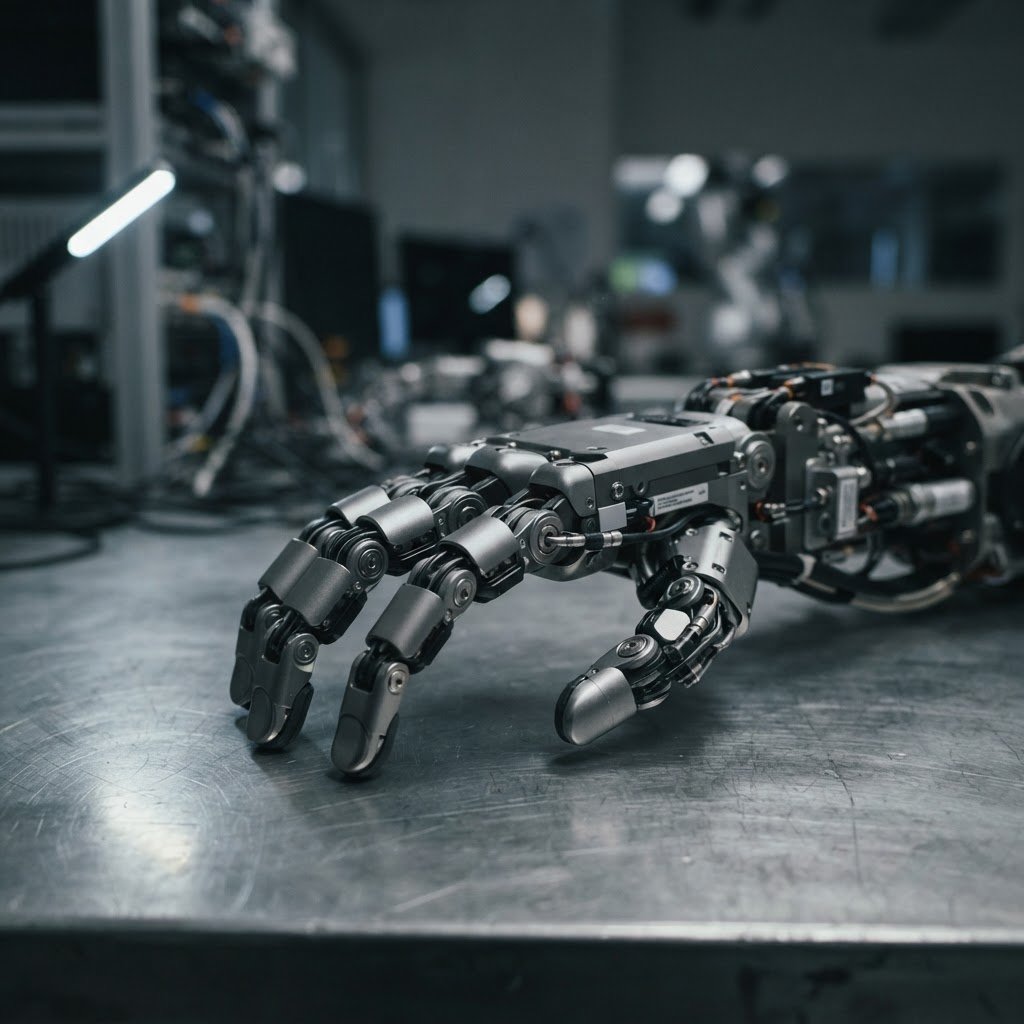
A humanoid robot is a mobile, human-shaped system intended to use human-oriented spaces and tools, whereas an industrial arm is typically a fixed or rail-mounted manipulator designed around a bounded work envelope. That distinction drives nearly every commercial trade-off: arms concentrate performance on one repeatable motion set, while humanoids must combine perception, balance, navigation, grasping, and task execution. The future of humanoid robotics will be decided by whether that broader stack can meet production requirements without creating a larger reliability burden.
Why specialized arms still dominate structured work
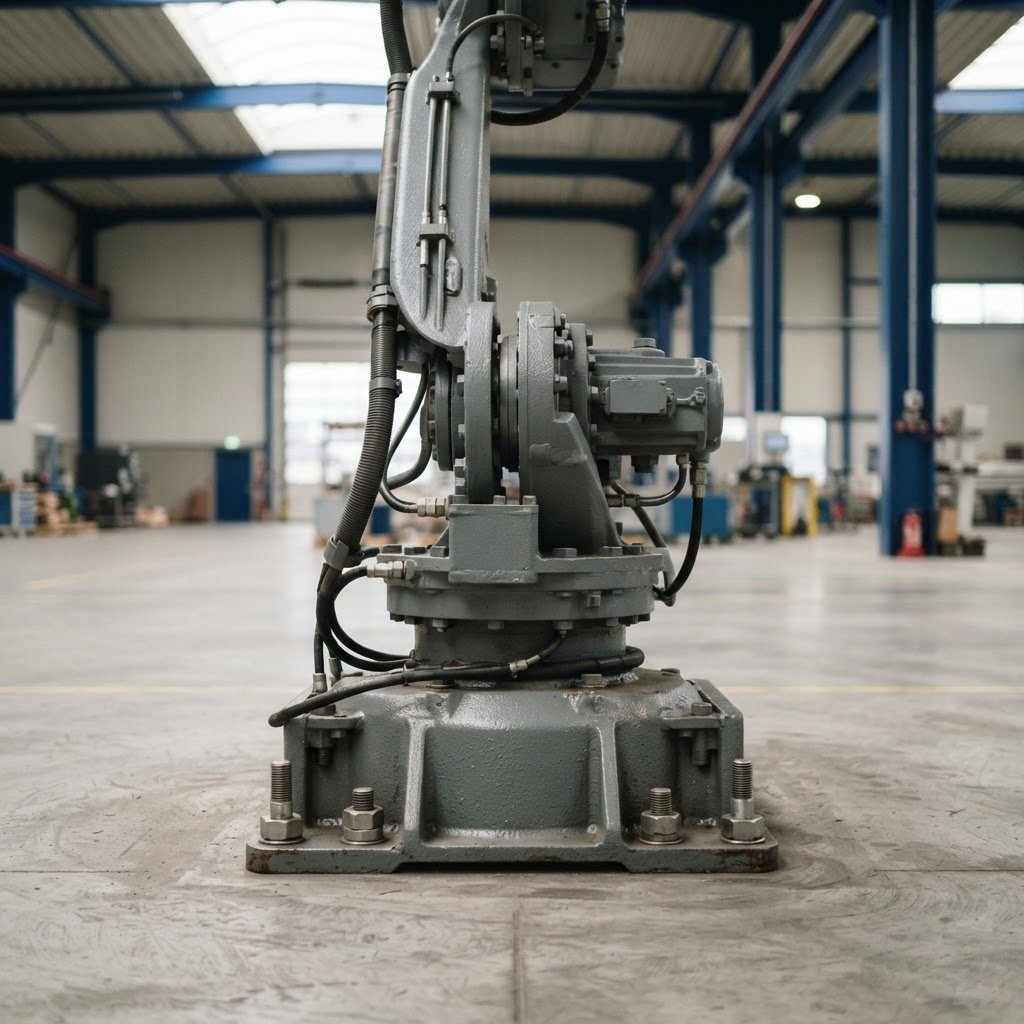
For welding, machine tending, dispensing, packaging, and other stable workflows, a fixed arm can be positioned around the part, fixture, and tool it must handle. Its motion path is constrained by design, which simplifies validation, maintenance planning, guarding, and throughput measurement. This does not make industrial humanoid robot applications irrelevant; it makes them more credible when a task genuinely requires human-scale reach, movement, or access.
Work envelope: Arms operate inside a defined, engineered zone.
Tooling: End effectors match known parts and motions.
Repeatability: Fixed fixtures reduce environmental variation.
Integration: Cells can isolate equipment from pedestrian traffic.
Why the humanoid form remains technically expensive
Humanoids inherit the complexity of the spaces they enter. Stability analysis for bipedal robots must account for uneven surfaces, obstructions, load shifts, recovery behavior, and people moving nearby, while an arm often avoids those variables by staying bolted down. A humanoid can potentially reuse human work areas, but that advantage disappears if it needs extensive environmental changes, constant intervention, or conservative speed limits to remain safe.
The clearest 2026 evidence of what that threshold actually looks like comes from Figure AI's own report on an 11-month Figure 02 deployment in BMW's Spartanburg body shop: the robots logged more than 1,250 operating hours and loaded over 90,000 sheet-metal parts, contributing to the assembly of more than 30,000 BMW X3 vehicles before the pilot concluded and BMW moved to a logistics-focused assignment with a newer model.[2] That is a genuine production result, not a demo, but it is still one task, one plant, and one vendor's self-reported figures, which is exactly the kind of result that needs independent replication before it generalizes to a buying decision.
Cost, Flexibility, Dexterity, and Safety Compared
Cost comparisons require discipline because robot pricing, deployment scope, and service terms are commonly custom or undisclosed. The relevant budget is not a sticker price: it includes end effectors, vision, safety systems, controls integration, commissioning, maintenance, spares, facility changes, and the operational labor needed to handle exceptions. Investors assessing the humanoid technology market should compare equivalent completed workflows, rather than a publicity demonstration with an established robotic cell, with the same scrutiny covered in AI due diligence versus manual review for technical claims generally.
What the comparison looks like on the factory floor
The table separates inherent design characteristics from commercial claims that have not been publicly standardized across vendors. Tesla Optimus and Figure AI are visible names in the current humanoid discussion, but neither should be treated as interchangeable with a conventional robotic arm merely because both can move objects. A company evaluating either category needs a task-level acceptance plan that defines the objects, locations, cycle constraints, handoffs, failure states, and safety procedures.
Criterion | Humanoid robots | Industrial robotic arms |
|---|---|---|
Physical layout | Designed to move through human-scale spaces. | Designed for fixed cells or defined mounted positions. |
Task variation | Can address varied locations and human-oriented tools. | Performs best with stable part presentation and repeatable paths. |
Mobility burden | Requires navigation, balance, and route recovery. | Usually avoids whole-body mobility during operation. |
Dexterity challenge | Must coordinate hands, arms, vision, and body posture. | Uses task-specific end effectors within constrained motion. |
Commercial pricing | Deployment pricing is commonly undisclosed or custom. | System pricing is commonly custom to cell design and tooling. |
Safety design | Must manage motion around changing work areas. | Often uses engineered separation and guarded zones. |
The decisive difference is controllability. An arm gains predictability by narrowing the job and shaping the environment; a humanoid seeks value by accepting more environmental variation, which also enlarges the test surface before dependable deployment.
Safety is a system property, not a robot category
Neither category is safe by default. Workplace safety requirements are ongoing: safety and health professionals must ensure that robot use does not create additional hazards or risks for workers.[3] For arms, that often means evaluating cell access, unexpected starts, tooling, and handoff points; for humanoids, it also includes navigating autonomously, falls, proximity to people, and unpredictable object interactions.
Human-robot interaction design should define who can pause the system, what happens after an error, how the robot signals intent, and when a worker can enter the operating area. The CDC notes that safety and health professionals must continually ensure robot use does not create additional hazards or risks to workers.
A pilot that measures only successful repetitions can hide the events that matter most in production, such as recovery from a dropped item, blocked aisle, misplaced tote, sensor failure, or altered workstation.
Where Each Robot Category Creates Commercial Value
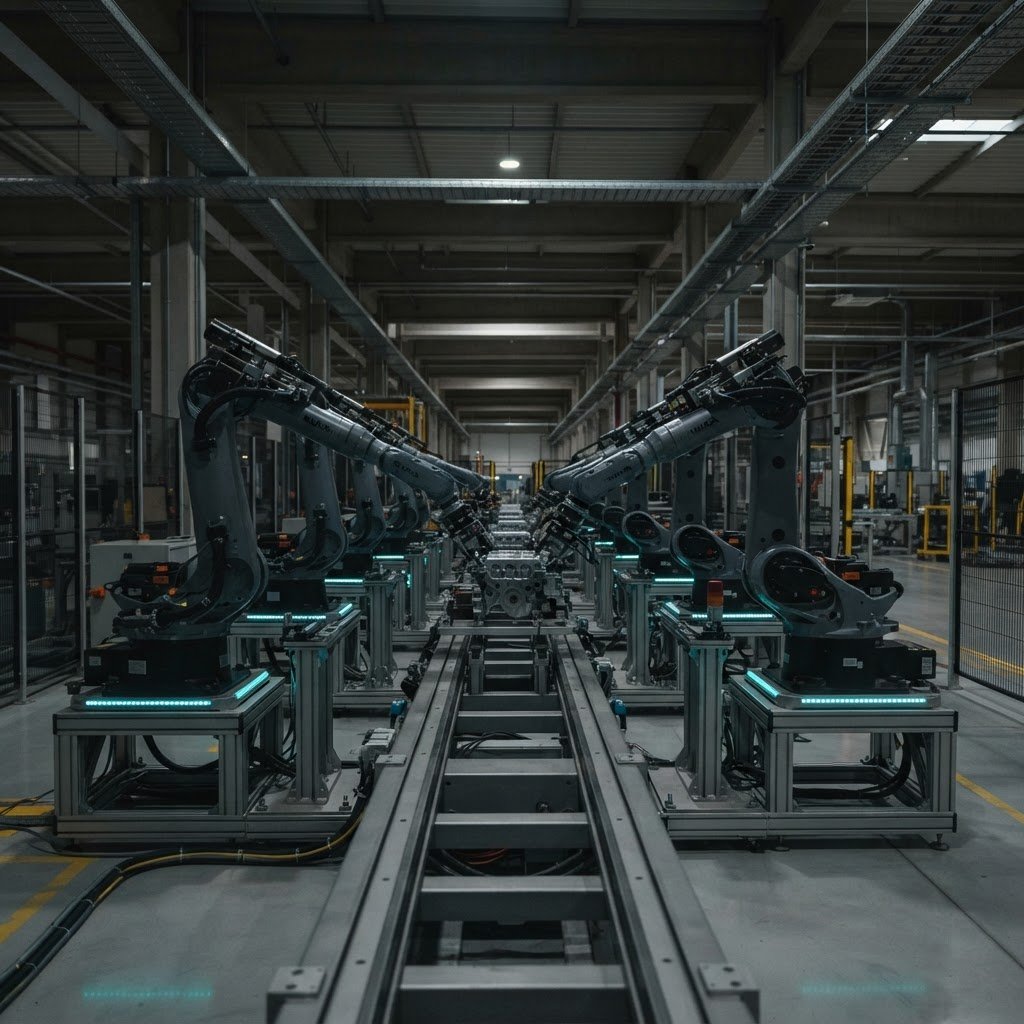
Industrial arms create value when the work can be engineered into a repeatable cell. This is the appropriate baseline for high-volume tasks because dedicated fixtures, end effectors, and predictable material flow reduce the number of decisions the system must make. Kinematics and dexterity still matter, but the arm only needs the degrees of freedom and sensing required by its assigned operation.
Tasks that justify testing a humanoid
Humanoids become commercially interesting when physical flexibility has direct operational value: moving between stations, using infrastructure built around human dimensions, handling varied objects, or performing work that would otherwise require extensive cell redesign. Research on integrating humanoid robots identifies adaptive locomotion, safety, ethical, and workforce considerations as central challenges, not peripheral details.[4] The research presents a comprehensive roadmap for construction integration that addresses adaptive locomotion, workforce impacts, and ethical considerations. That makes a tightly scoped pilot more useful than a broad claim of general-purpose autonomy, similar to how a BMW-scale deployment still represents one vendor's results on one task.
Power efficiency is also task-specific when comparing humanoids with arms. A mobile, bipedal system spends energy on standing, balance, sensing, computing, and travel, while an arm directs its activity within a defined station. The comparison should record productive work, idle behavior, recovery events, charging or power interruptions, and the effect of load changes rather than reducing efficiency to a single abstract specification.
How to evaluate a pilot without being misled
Start with one task that has meaningful variation but clear boundaries, then document every exception rather than averaging it away. Measure the robot's ability to identify the correct object, complete the handoff, recover safely, accept supervision, and resume after interruption. TechBriefed's daily technology analysis is useful context for tracking this market, but a deployment decision still requires site-specific evidence rather than vendor narratives.
Conclusion
Industrial robotic arms win in 2026 for most defined manufacturing operations because their fixed geometry, dedicated tooling, and controlled cells support more predictable deployment. Humanoid robots deserve serious testing where existing facilities force people to move between variable tasks and human-scale workstations. The right decision is to model the full workflow, including exceptions and safety controls, before comparing capital outlay or demo performance. That assessment should include whether robot use creates additional hazards or risks for workers, consistent with CDC guidance that safety and health professionals must continually evaluate those risks. For technology leaders seeking a clear lens on these shifts, TechBriefed offers concise analysis of the commercial and technical signals behind automation claims.
Need a sharper read on robotics developments? TechBriefed offers practical technology analysis.
Frequently Asked Questions (FAQs)
What are the primary use cases for humanoid robots in industry?
Humanoid robots in industry are primarily being tested for tasks that require movement through human-designed spaces, handling varied objects, and operating across multiple stations, although each deployment still needs defined safety procedures, exception handling, and supervision requirements.
Can humanoid robots perform complex manual labor?
Humanoid robots can perform selected complex manual tasks when the objects, workspace conditions, sensing demands, and recovery procedures are controlled, but robust performance remains harder when work involves frequent variation, uncertain contact, or changing human activity nearby.
How will humanoid robots change manufacturing processes?
Humanoid robots will change manufacturing processes by making some existing human-oriented layouts more automatable, while factories will still need to redesign task definitions, material presentation, worker handoffs, maintenance routines, and safety controls around real operating conditions.
How much does a professional humanoid robot cost?
A professional humanoid robot does not have a universally published cost because commercial arrangements can include the hardware, software, integration, support, safety equipment, facility changes, and operational services required for a specific deployment.
Is AI the key to unlocking humanoid robot autonomy?
AI is important to humanoid robot autonomy because it can improve perception, planning, and adaptation, but autonomy also depends on reliable hardware, control systems, manipulation, navigation, safety behavior, and recovery from real-world errors.
What is the future of humanoid robots in the workforce?
The future of humanoid robots in the workforce will depend on whether they can perform bounded jobs safely and consistently enough to justify integration, while employers, workers, and safety teams determine how responsibilities and oversight change around them.
Which is better: Tesla Optimus or Figure AI?
Tesla Optimus versus Figure AI cannot be resolved as a universal winner from public demonstrations alone because a meaningful comparison requires equivalent task definitions, measured reliability, integration scope, safety performance, support terms, and total deployment cost.
Sources
- History of robots - Wikipedia — en.wikipedia.org ↩
- F.02 Contributed to the Production of 30,000 Cars at BMW — Figure AI ↩
- Robotics in the Workplace: An Overview — Robotics ↩
- Opportunities challenges and roadmap for humanoid robots in construction - Scientific Reports — Nature ↩
About the author

 MCP Server vs REST API: Which Fits Your AI Agent Stack 2026?
 AI Due Diligence vs Manual Review: Which Wins for M&A Teams?
 AI Agents vs RPA: Which Automation Wins 2026
 Seed Funding vs Bootstrapping: Which to Choose 2026
 AI Chips vs GPUs: Which Wins for AI Workloads in 2026?