Confidential Computing vs Encryption: Which Wins in 2026?
A technical comparison of confidential computing and encryption, examining how each protects data and which approach makes sense for modern cloud and AI workloads in 2026.
By Riley Cho · 8 min read ·

Quick Answer
Confidential computing wins for sensitive workloads that must stay protected while processing, while encryption remains mandatory for data at rest and in transit. They are complementary controls, not interchangeable products: encryption protects ciphertext outside an application, and a trusted execution environment protects approved code, memory, and secrets when data must be readable to compute.

Introduction
For CTOs handling proprietary models, regulated records, or partner data, confidential computing closes the security gap that standard encryption leaves open: data in use. Encryption is still the baseline because every serious workload stores and moves data. The architectural decision is whether the risk of a privileged cloud, host, or runtime layer seeing plaintext justifies enclave-based isolation. In 2026, the answer increasingly turns on whether an AI workload can prove where its prompts, context, and model inputs were processed.
Key Takeaways
Encryption protects stored and transmitted data, but it does not isolate active computation.
Confidential computing protects plaintext processing inside an attested hardware boundary.
Use both controls when sensitive workloads run on shared cloud infrastructure.
Confidential Computing vs Standard Cloud Encryption
The central distinction is simple: encryption protects data when it is sealed, while confidential computing protects it during execution. That matters because applications ordinarily decrypt inputs into memory before processing them, creating exposure to privileged infrastructure software and operational access paths. A sound confidential computing architecture adds a hardware-backed boundary around that active workload rather than treating encrypted storage as a complete security model.
What each control actually protects
Encryption converts plaintext into ciphertext using cryptographic keys, then restores plaintext only for an authorized process. Confidential computing keeps that authorized process inside a trusted execution environment, or TEE, where the processor isolates execution and protects workload assets while the data is in the clear.
Data at rest: Encryption protects disks, backups, and object storage.
Data in transit: Encryption protects network traffic between endpoints.
Data in use: Confidential computing protects active memory and execution inside a TEE.
TEE scope: Hardware and software, not purely algorithmic methods.
Attestation and key release: Policies verify an approved hardware and software state before releasing secrets only to that attested environment.
Why memory is the decisive gap
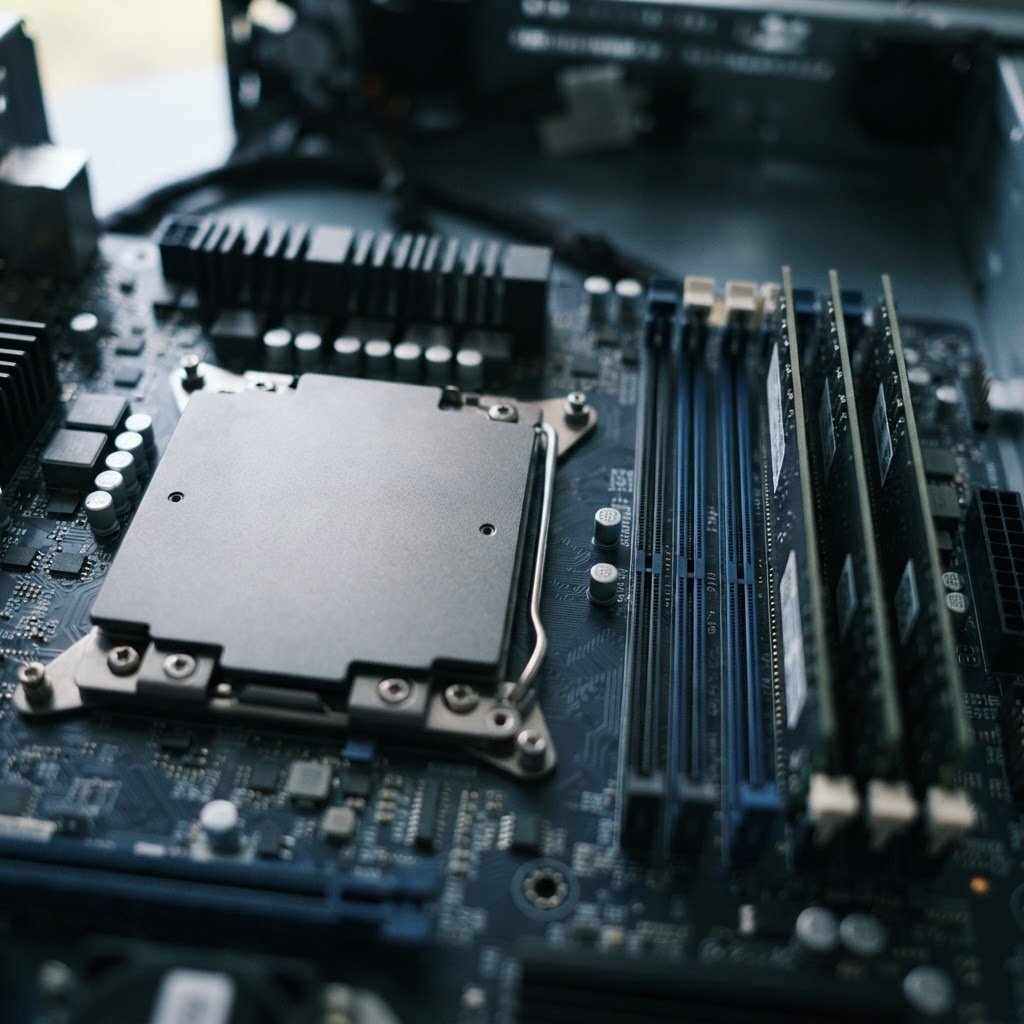
Trusted execution environments matter because efficient processing requires data to be readable somewhere.[1] A TEE provides isolated execution, application integrity, and confidentiality for its assets, so the workload can operate on plaintext without broadly exposing it to surrounding software. This is not merely encryption of data in memory; it is an enforced execution boundary with a measured identity that a remote party can verify. Many of the same infrastructure-layer exposures show up in zero-day vulnerability risks, where a compromised host or privileged process can reach data the application assumed was isolated.
Threat Models That Justify a TEE
Deploy confidential computing when the adversary model includes infrastructure layers that traditional application controls do not fully trust. That can include a compromised host, a malicious administrator, or a multi-party workflow in which one participant must validate the runtime before releasing sensitive inputs. It does not replace secure code, identity controls, logging, or key management. Organizations weighing this decision often look to emerging AI governance frameworks for how attestation and runtime verification should be documented and audited.
When encryption is enough and when it is not
For a routine service with tightly controlled hosts and no unusually sensitive processing, encrypted disks, encrypted connections, least-privilege access, and disciplined key handling may be the proportionate design. For high-value data processed in shared infrastructure, those controls still leave a moment when the application needs plaintext in memory.
Confidential computing is the better architectural answer when data owners need a verifiable boundary around that moment. NIST guidance addresses encryption for data in use and the security role of trusted execution environments.[2] The relevant hardware-enabled security model centers on a TEE, cryptographic keys, machine identity, and hardware security controls.
Decision point | Standard encryption | Confidential computing |
|---|---|---|
Primary protection stage | Data at rest and in transit | Data in use during approved execution |
Runtime plaintext | Available to the application environment | Confined to a TEE boundary |
Workload verification | Authorization to access keys | Remote attestation of hardware and software integrity |
Operational dependency | Key management and access controls | Key management, attestation, and enclave-aware deployment |
Best security outcome | Baseline protection for every workload | Additional isolation for sensitive processing |
The practical conclusion is not to replace encryption with enclaves. Keep encryption everywhere, then add confidential computing where the runtime itself must earn trust before it receives data or keys.
Performance and implementation costs are real
TEEs add engineering work because the build, deployment, secret-release, and observability paths must recognize an attested runtime. The exact overhead depends on the processor, instance type, workload behavior, and software stack, so no universal performance figure is credible. This is especially visible in AI chip workload performance, where enclave-aware deployment adds a layer teams must test before committing production security targets. Teams should test representative inference, batch, and service paths before committing production security targets.

Confidential Computing in Artificial Intelligence
AI is where the case for confidential computing becomes concrete. Prompts, retrieval context, proprietary documents, model inputs, and intermediate outputs can all be commercially sensitive, yet they need to be processed in readable form. Protecting that processing boundary reduces the number of infrastructure actors that could access the data.
Use attestation before releasing AI data
The right workflow is attestation first, secret release second. A data owner verifies the intended environment, then permits keys or inputs to reach that measured workload; if the environment does not match the expected state, the sensitive material stays withheld. This is a better fit for applying zero trust principles to confidential computing than a blanket assumption that any authenticated compute instance deserves access. It also narrows the surface for AI prompt injection risks, since a compromised prompt path still cannot reach data outside the attested boundary.
Google Cloud documents that its confidential computing environment can protect sensitive datasets and generative AI workloads, including user prompts, from host infrastructure, cloud operators, and AI platform providers. It also states that the processor blocks software-based access to the confidential computing environment. Its remote attestation process checks hardware and software integrity before establishing trust, which is the mechanism teams should evaluate rather than a provider label alone.[3]
Do not confuse TEEs with homomorphic encryption
Confidential computing vs homomorphic encryption is not a clean substitute comparison. Homomorphic encryption is a mathematical approach to computation on encrypted data, while confidential computing relies on hardware and software isolation for processing plaintext inside a protected environment. The Confidential Computing Consortium explicitly scopes its hardware and software focus separately from purely algorithmic technologies such as homomorphic encryption and multiparty computation. Teams building AI products on this model should see how enterprise AI agent platforms are starting to bake attestation into their default deployment paths rather than treating it as an add-on.

How to Make the Architecture Decision
Start with the data flow, not the cloud product menu. Identify who owns the data, which component must see plaintext, where keys are released, and which infrastructure layers are outside the trust boundary. If the answer includes cross-organization processing, highly sensitive AI inputs, or privileged-host risk, confidential computing should be in the design review.
Build a narrow proof of value
Begin with one workload that has a clear confidentiality requirement and a measurable owner. Put the attestation policy next to the key-release policy, verify that the application behaves correctly inside the enclave, and rehearse failure handling when attestation changes. Avoid a broad platform rollout before the team can operate the trust chain under incident conditions.
Evaluate providers by controls, not branding
Confidential computing features from AWS, Azure, and GCP should be assessed through the available hardware isolation, attestation evidence, supported workload types, migration behavior, and integration with your identity and key systems. Google Cloud documents hardware-backed protection for data during processing and remote attestation that verifies the confidential computing environment's hardware and software integrity. That is the level of operational detail worth testing in a pilot, rather than relying on a generic confidential-computing claim.
Conclusion
Encryption is the non-negotiable foundation, but it does not answer the risk of sensitive data being processed in plaintext. Confidential computing adds a hardware-backed trust boundary for the workloads where that exposure matters, especially shared-cloud AI and multi-party data processing. Use encryption everywhere and make confidential computing the default evaluation for high-sensitivity workloads that require verifiable runtime isolation. Treat attestation, key release, and operational testing as one system, or the enclave will be a security feature without an enforceable trust policy.
Need sharper infrastructure analysis without the vendor fog? Follow TechBriefed for the technical shifts worth acting on.
Frequently Asked Questions (FAQs)
What is confidential computing?
Confidential computing is a security approach that processes readable data inside a hardware-backed trusted execution environment, isolating the workload and protecting its code, memory, and secrets from surrounding software layers.
How does confidential computing work?
Confidential computing works by placing an approved workload in a TEE, then using attestation to verify the environment's hardware and software integrity before sensitive keys or data are released.
Is confidential computing the same as encryption?
Confidential computing is not the same as encryption because encryption protects data while stored or transmitted, whereas confidential computing adds protected execution for data that must be readable during computation.
Can confidential computing prevent cloud data breaches?
Confidential computing cannot prevent every cloud data breach because application flaws, stolen credentials, and unsafe data handling remain risks, but it can reduce exposure from unauthorized access to an active workload's runtime environment.
Why should CTOs invest in confidential computing?
CTOs should invest in confidential computing when sensitive data must be processed on infrastructure outside their full trust boundary, because attestation can make key release conditional on a verified runtime state.
What are the main challenges of confidential computing?
The main challenges of confidential computing are enclave-aware deployment, attestation policy design, key-release integration, debugging constraints, and workload-specific performance validation across the complete production path.
How do hyperscalers implement confidential computing?
Hyperscalers implement confidential computing through hardware-backed isolated environments with attestation controls, while supported platforms may also protect memory during operations such as confidential live migration.
Sources
- governance/scoping.md at main · confidential-computing/governance — GitHub ↩
- NIST guidance — nvlpubs.nist.gov ↩
- Confidential Computing overview | Google Cloud Documentation — Google Cloud Documentation ↩
About the author

 Quantum Computing vs Classical Computing: 2026 AI Guide
 Edge Computing vs Cloud Computing: Which Wins for AI in 2026
 What Is Cloud Computing? A Beginner’s Guide for 2026
 AI Research Tools vs Traditional Research Methods 2026