Can AI Replace Human Writers? Here's What Experts Say
Can AI truly replace human writers? We break down expert opinions, real-world comparisons, and the limitations every tech professional should know.
By Alex Mercer · 7 min read ·

Introduction#
The debate around whether AI can replace human writers has shifted from speculative to operational. CTOs are evaluating AI writing tools for documentation pipelines, marketing leads are testing machine-generated copy against human output, and newsrooms across the United States are experimenting with automated reporting at scale. The question is no longer about capability in a vacuum. It is about where AI content generation vs human writing actually holds up under the pressures of accuracy, nuance, brand voice, and trust, and where the seams start showing.
Where AI Writing Tools Excel Today#
To have a clear-eyed conversation about AI vs human writers, you first need to acknowledge what the current generation of large language models does genuinely well. Dismissing AI writing outright is just as unhelpful as overhyping it.
Where Do AI Writing Tools Actually Outperform Humans?#
AI writing tools have a clear advantage in tasks that prioritize throughput over originality. For repetitive, structured content types, the efficiency gains are measurable and significant.
Product descriptions: AI can generate hundreds of SKU-level descriptions in minutes, following consistent formatting rules that would take a human team days to replicate.
Data-driven summaries: Earnings reports, sports recaps, and weather updates are well-suited to automation because the source material is structured and factual.
First drafts and outlines: Many professional writers now use GPT writing capabilities to produce rough drafts they then reshape, cutting initial drafting time by 30 to 50 percent.
Internal documentation: API docs, changelogs, and knowledge base articles benefit from AI's ability to synthesize technical inputs into readable prose quickly.
Why Benchmarks Can Be Misleading#
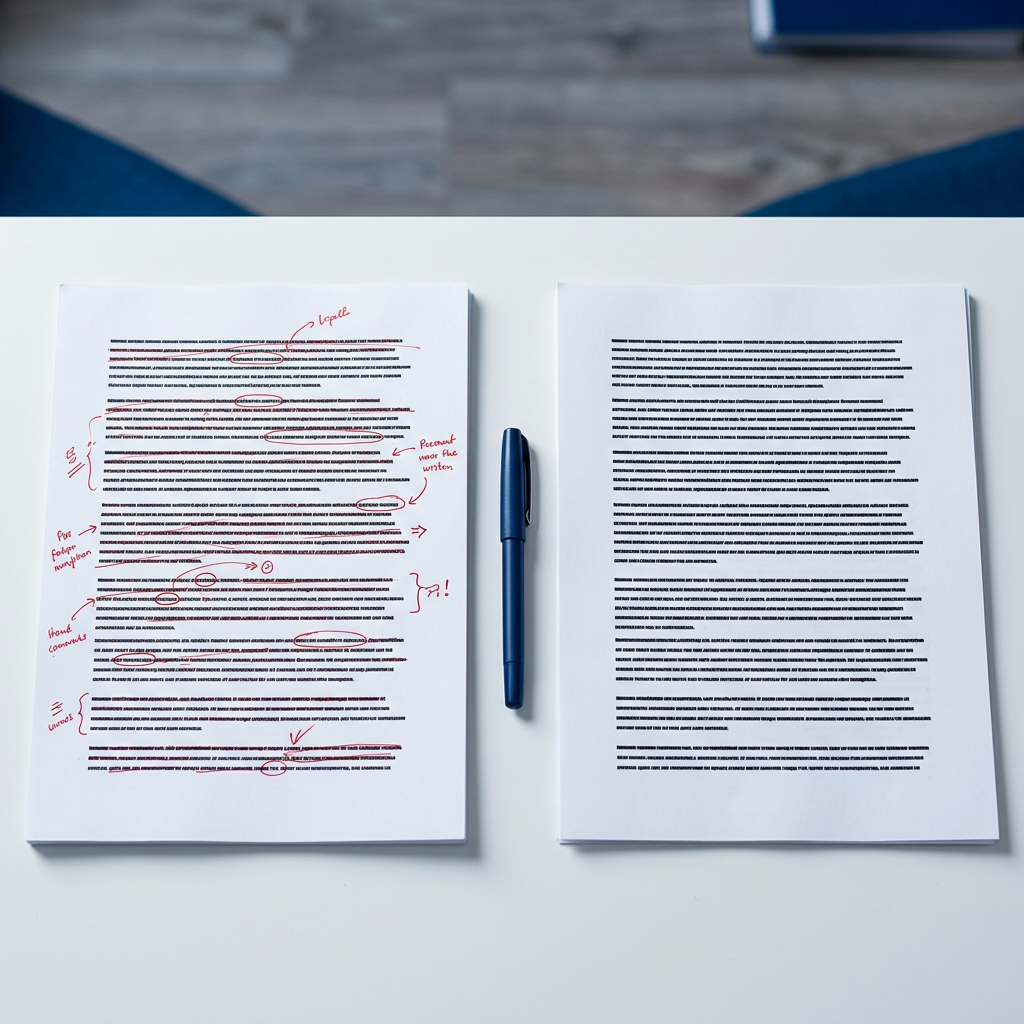
Much of the hype around AI writing quality compared to humans comes from benchmark tests that measure fluency, grammar, and coherence in isolation. These tests often present AI-generated text alongside human text and ask evaluators to pick the "better" sample, and AI frequently wins on surface polish. But polish is not the same as substance. As recent analysis has shown, benchmark performance rarely translates cleanly to real-world editorial quality, where factual precision, audience awareness, and strategic framing matter far more than sentence-level smoothness.
Where AI Consistently Falls Short#
The limitations become obvious the moment you move beyond templated output into content that requires judgment, lived experience, or accountability. These are the areas where the gap between AI copywriting vs human copywriters remains wide, and where the cost of getting it wrong is highest.
Why Is AI Writing Accuracy Still a Problem?#
AI writing accuracy and reliability remain the single biggest barrier to unsupervised deployment. Large language models generate text by predicting statistically probable sequences of words, not by verifying claims against a knowledge base. This means they hallucinate: confidently stating factually wrong things, citing papers that do not exist, and attributing quotes to people who never said them.
For newsrooms, this is a non-starter for anything beyond commodity reporting. The Associated Press uses automation for earnings summaries, but every piece that involves analysis, sourcing, or context still requires a human reporter. Research published by MIT's Open Mind journal documents how LLMs struggle with reasoning tasks that require evaluating conflicting evidence, precisely the kind of cognitive work that separates journalism from transcription. Machine-generated journalism may handle the "what," but it consistently fumbles the "why" and "so what." If your content strategy depends on building reader trust, an unchecked AI pipeline introduces reputational risk that no amount of speed can justify.
What Can Human Writers Do That AI Still Cannot?#
Ask an AI tool to write a blog post, and you get competent, mid-register prose that could belong to anyone. Ask a skilled writer to cover the same topic, and you get a piece shaped by editorial judgment: what to emphasize, what to leave out, and how to frame information so a specific audience acts on it. The skills humans have over AI writers are most visible in content that requires persuasion, irony, cultural awareness, or the ability to read a room. AI companies are quietly hiring philosophers and humanists precisely because they recognize this gap.
A 2025 study in Nature Humanities and Social Sciences Communications found that while readers rated AI text as more grammatically consistent, they rated human-written text significantly higher on engagement, originality, and emotional resonance. For tech companies trying to differentiate through thought leadership, this distinction is critical. You cannot build a brand voice on statistically average sentence patterns.
The Hybrid Model: What Actually Works#
The most productive framing is not "AI vs. humans" but "AI and humans, deployed to their respective strengths." The organizations seeing the best results in the US tech industry are the ones treating AI as infrastructure rather than a replacement for editorial judgment.
How Leading Teams Structure Hybrid Workflows#
At companies like HubSpot and Shopify, content teams use AI tools for first-draft generation, SEO metadata, and content briefs, then route everything through human editors for fact-checking, voice alignment, and strategic coherence. The AI handles volume. The human handles value. This workflow cuts production time without sacrificing the editorial quality that builds audience trust over months and years.
For decision-makers evaluating GPT-5 vs Claude for developer workflows, the same logic applies. These models are converging on similar capabilities for structured tasks, but neither has solved the problem of reliable original analysis. TechBriefed has covered this convergence extensively, and the consistent finding is that the model matters less than the workflow you build around it. A strong editor with a capable AI tool will outperform either an AI working alone or a writer working without one.
Does AI Writing Actually Save Money? The Real Cost Analysis#
The human writers vs AI tools cost analysis is more nuanced than the headline numbers suggest. Yes, AI-generated content costs a fraction per word compared to hiring a professional writer. But the total cost of ownership includes editing time, fact-checking labor, revision cycles for hallucinated content, and the harder-to-quantify cost of publishing mediocre work that erodes brand credibility. For high-volume, low-stakes content (product feeds, internal summaries), AI delivers clear ROI. For anything client-facing, the editing overhead often narrows the cost gap to the point where the "savings" become marginal.
A practical rule of thumb emerging from content operations leads across the AI industry: if a piece of content requires more than one round of substantive human editing after AI generation, it was probably cheaper to have a human write it from scratch. This does not mean AI content generation platforms lack value. It means their value is concentrated in specific use cases, not in wholesale replacement of editorial thinking.
Conclusion#
The answer to whether AI can replace human writers is specific, not binary. AI tools have earned their place in content pipelines for structured, high-volume, low-ambiguity tasks. They have not demonstrated the ability to replace human judgment in work that requires accuracy under pressure, original analysis, cultural fluency, or strategic voice. The organizations making the smartest bets right now are investing in hybrid workflows that pair AI efficiency with human accountability, and they are doing it with clear-eyed cost models rather than hype-driven assumptions.
Get the daily signal on AI developments that matter at TechBriefed.
Frequently Asked Questions (FAQs)#
Can AI write better than humans?#
AI often produces more grammatically polished text, but human writers consistently outperform AI on originality, emotional resonance, and strategic framing that drives reader engagement.
What are the limitations of AI writers?#
The primary limitations are factual hallucination, inability to verify claims, lack of genuine reasoning about ambiguous or conflicting information, and absence of authentic voice or lived perspective.
Is AI writing accurate enough for news?#
AI writing is reliable for structured, data-driven news formats like earnings summaries, but it is not accurate enough for investigative, analytical, or source-dependent journalism without heavy human oversight.
What is the future of AI writing?#
The future points toward hybrid workflows where AI handles first drafts, outlines, and structured content while human writers and editors focus on analysis, voice, and factual accountability.
Is AI writing cost-effective for businesses?#
AI writing is cost-effective for high-volume, low-stakes content, but the editing and fact-checking overhead for complex or client-facing work often erodes the savings to the point where human writers remain competitive on total cost.
About the author